The farm where I grew up in Northfield spanned a couple of hundred acres. Woodland outsurpassed the open fields in acreage by well over half. A large portion of the forest was used as pasture. The pasture for the milking herd was on the far side of the road. Amidst the mixed forest, hidden meadows of lush grass existed. Over the years, my father built upon the meadows by expanding, caring for, and nurturing them. The cows needed to be driven to pasture down a hill about a third of a mile and across the road. We lived at the top of a mile-long dead-end road. For the most part, it took two people to cross the cows: one to drive and one to work the gates. My father worked the gates, and I was the driver. I especially enjoyed hopping onto my pinto pony bareback to get the job done.
My father was a good gate builder—too good, according to my mother—his gates were more than substantial, weighing a lot and hard for my mother and me to handle. This particular set of gates was designed to open into one another, with each gate halfway across the road, meeting in the middle. In those days, the town roads were much narrower than they are today. The cows lumbered down the path in the night pasture to get to the day pasture crossing. The cows made their way single file along their self-made and well-worn dirt cowpath that traversed the hillside. There was always a leader, and nine times out of ten, it was the same cow. There were always a few of the same stragglers that dallied along, and that's the way it was. If by chance a cow entered the barn out of the usual sequence, it spelled chaos. Chances were always good that they would mess up and take the wrong stanchion in the barn. That would mean closing the barn doors for a moment and straightening out the mess. How those first few cows entered a stable that tied 35 cows, and chose the right stantion remains beyond me to this day. There were times when we would even get mixed up, and the cow would set us straight.
The heifers had an especially carefree life the summer before freshening. They had the run of a large pasture that included the sugar woods and another section we called the spruces. The spruces were a magical ecosystem—dank and cool—not only spruce trees grew there, but also stands of mature hemlock, pine, and balsam, and an abundance of moss. Rocks appeared as mounds of plant life like miniature botanical gardens. The heifers didn't need to come back to the barn like the milking cows. Instead, they made their own schedule by grazing a little here and there and spent hot days amongst the softwoods in a bed of moss.
How I loved the sweet scent of the heifers. To me, a pastured herd of heifers has a distinctive smell that I savor to this day. In theory, we were implementing what today would be called a silvopasture system. There wasn’t a fancy term for it back then, but it worked well for us on our farm and forest until the practice of forest grazing was largely discouraged by agricultural economists. Silvopasture is once again making a comeback in this country because of the carbon it can sequester, both above- and belowground, ranking ninth among the top 100 solutions to climate change, according to Project Drawdown, a leading resource for climate solutions. In other places around the world, such as among farmers in the Lake District of England, the idea of silvopasture has never been abandoned, with further enhancements achieved by rotating livestock species within a given forest. The heifers and the cows did a fine job. The woods were easier in those days to get around in, with far less slash and undergrowth. Invasives were fewer, and grassy areas were encouraged. A symbiotic relationship seemed to emerge: the trees provided shade, shelter, and well-being for the livestock, while the forest benefited from the gift of added nutrients.
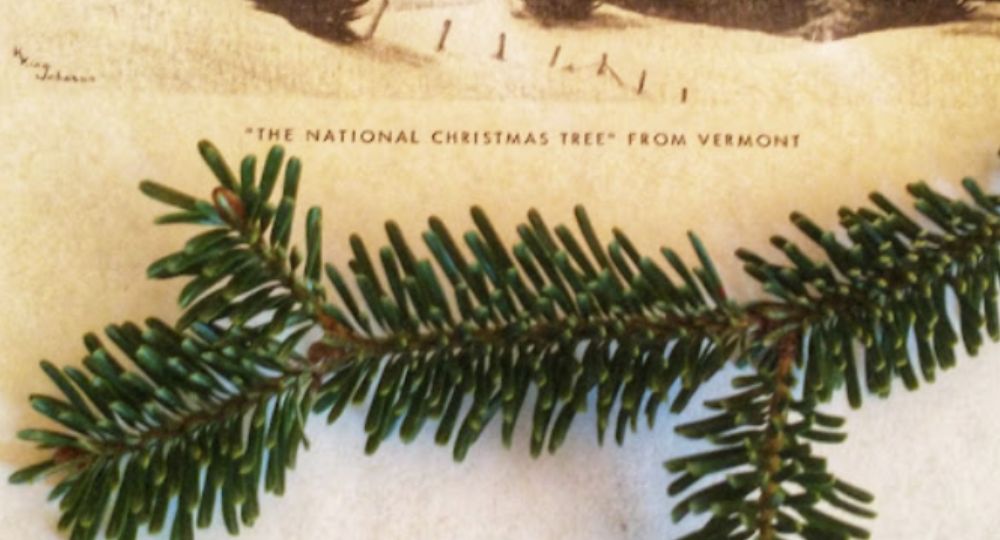
Forest grazing left the spruces perfect for Christmas tree picking, with no brushy tangles to walk through. Several grassy knolls scattered throughout the forest were found along the perimeter, where the best selection of balsams grew. Balsam was our tree of choice because it tends to have a nicer shape than spruce, with richer, darker green needles. Spruce needles are prickly to the touch, and balsam boughs have a soft feel, and the spicy fragrance of a balsam is the most wonderful of all. We weren't all that fussy about choosing a tree. After all, as long as a tree had one good side, the not-so-good side could always be turned to face the wall. Decorations helped, and in those days, we used a lot of icicles; strips of tinsel made from aluminum that reflected the light, filling the spaces between the branches.
Every year, a few people asked if they could harvest a tree from our land. Usually, they were folks who had moved to the area from somewhere else and were accustomed to well-groomed plantation trees. Some returned the following year, but most did not. Finding a perfect tree wasn't that easy. Perfectionism amongst wildlings required a lot of looking and a lot of walking through deep snow. The terrain was steep, and once a tree was harvested, it had to be dragged uphill to the vehicle. And then there were my father’s barbed-wire fences. A lot of folks got their pants ripped by the barbs and their legs bloodied by scratches. Not only was my father a good gate builder, but he was also a good fence builder. His fences were built straight, true, and tightly strung. I was good at maneuvering the fences as a kid, but most folks unknowingly weren’t.
Over the years, I’ve learned a thing or two about going into the woods to harvest a wild tree.
Like the year we found a perfect spruce tree. It was a beautiful spruce, but once we brought it inside and decorated it, it smelled like cat pee. We had a cat that occasionally came into the house, and the blame was immediately placed on him. We soon discovered that the crushed needles had the same distinctive smell. Our perfect spruce turned out to be a white spruce, also known as cat spruce. We didn’t make that mistake again. And then there was the year my father and I found what we thought to be the perfect tree atop a 40-foot balsam. The tree was one that he had intended to weed out anyway to make room for some young maples. With a buzz of the chainsaw, the tree soon fell to the ground. Much to our disappointment, what looked to be the perfect tree wasn't; the treetop was skinny, the branches were thick and stiff, and worst of all, numerous sharp, erect central cores remained on the branches where ripening cones had given away and fallen apart. We didn't do that again.
And then there was the year I'll never forget. I was in seventh grade, and my father drove me to the village to buy Christmas gifts for my mother. He gave me some money and sent me into Morse’s Department Store on the Northfield Common to pick out a lovely dress. My mother didn't own many dresses. When she worked in the barn, she wore pants. She called her barn attire “glad rags.” When she went to town, she enjoyed wearing a dress and looking nice for the occasion. I found a dress that I thought she would look beautiful in. The store clerk wrapped the package in fancy gift paper and topped it with a pretty bow. I was so excited, I couldn't wait for Christmas morning. When it came time to harvest the Christmas tree, my father and I didn't go to the spruces as usual. Instead, we went to what we called the back pasture. We hunted and hunted, but found no desirable options. Just across the stonewall on the neighboring property, a tree caught our eye. A perfect tree in the remote corner of our neighbor's land. Surely they would never miss it. So we climbed over the stonewall, cut the tree, and dragged it home, every step knowing we had done wrong. As our luck would have it, my mother asked where we found such a beautiful tree. Of course, we couldn’t lie as that would add another layer to our wrongdoing. Despite my mother's punishing words, the tree was brought into the house and decorated. Beauty was diminished by guilt, an invisible black cloud casting a shadow. Sure enough, the day before Christmas, my mother slipped and fell in the barn while she was doing morning chores. She broke her ankle, and a bad break at that. Her ankle was never the same after that. The tree came down, and went out the door that very day. My mother spent Christmas Day in the hospital.
That was my first and last time I ever took something from someone that wasn't mine. It was a powerful lesson indeed. I was an adult the year I harvested a hemlock tree in memory of my grandmother, and to satisfy my curiosity about why the hemlock was her tree of choice. I never knew my grandmother; she died the year I was born. Over the years, I heard repeated stories about my grandmother's strict demands for a hemlock tree. As I expected, hemlock boughs are delicate and lack strength, so ornaments weighing more than a feather sadly slumped. Lack of fragrance was another strike against the hemlock. I did like the magical wispiness of the unadorned branches, but not enough so to harvest another hemlock. To this day, I wish I could ask her why the hemlock.
The Green Mountain National Forest is issuing Christmas tree permits this year. The permit allows up to two Christmas trees within designated areas of the National Forest. Permits cost five dollars per tree. Fourth Graders with Every Kid Outdoors passes are eligible for a free holiday tree permit. According to the Green Mountain National Forest Recreation website, “Lifelong memories are built during these special times.” I can certainly attest to that!