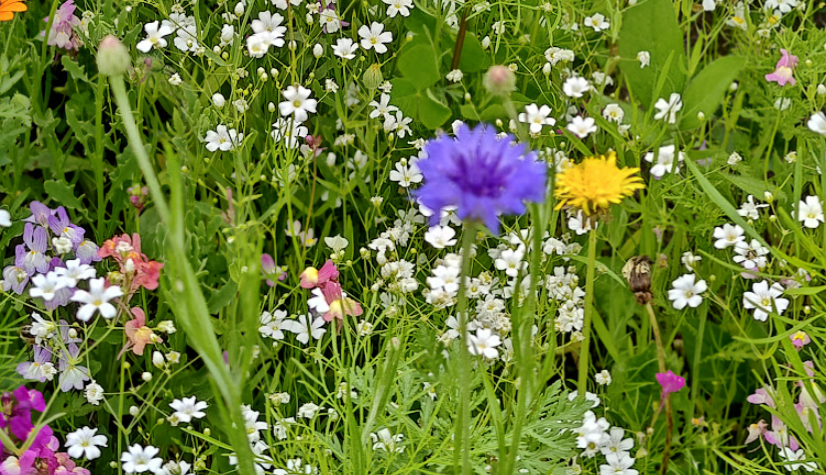
Bees and butterflies of all sizes drift from one flower to the next now that dog days of summer are upon us. It’s a special time of the year when the heat lingers into the evening, fireflies twinkle in the night sky, and flashes of heat lightning add to the show. Garden overwhelm has set in with peas, raspberries, and blueberries ready for the freezer, all demanding immediate attention. Every trip out the door and to the garden takes me past a meadow of wildflowers where I take time to see what's blooming new each day. I love watching the delicate flowers sway in the breeze. The diverse variety of wildflowers is better than I expected to see. This is the first year of the meadow's creation. Day by day, something new pops up that wasn’t there the day before. Currently, the meadow has taken on a Monet look that puts me into a dreamy state of reflection.
The early phase of summer brought an abundance of toadflax, a variety closely related to garden snapdragons, followed by the arrival of a cloud of white showy baby's breath. Then came the bachelor buttons in blues, whites, and pinks, followed by orange California poppies, and now cosmos sway amongst yellow, daisy-like mums, all adding a stunning palette of color.
Thinking back to the meadow’s beginning and the day we covered the intended area with black plastic, we chose a day when the wind was reasonably quiet, or so we thought. When the entire 100-foot roll was laid out, the wind came up. It's rare for the wind not to blow here, and that day was no exception. Sure enough, the wind stirred up some fun. All of a sudden, we had something big wanting to go airborne in our hands. Cuss words helped as the plastic heaved and flapped.
As if satisfied by the brief chaos it had created, the wind took a break. We worked fast, seizing the opportunity and laying down stones, pieces of old lumber, and a few wooden pallets. Finally, we got it finagled into place and hitched down adequately. The sea of black accentuated the project's scope, knotting my belly. Had we bitten off more than we could chew? It certainly wouldn’t be the first time. Bear in mind that as a married couple, we never do things small.
Once we thought the plastic was in place, we found out differently, as the bank was just steep enough for it to slide down the hill. Over the next couple of months, before the snow came to hold the plastic in place, we had to make a few adjustments here and there as gravity caused it to sag and wrinkle, reminding me of the aging process itself. When we unveiled the bank this spring, we were pleased with the job the black plastic had done in killing the grass.
Now, onto the next step. My husband and I aren't getting any younger, and the scope of this job was intimidating. So we called Nate and Katherine Snow. They have a machine equipped with brushes that seemed to fit the bill. Sure enough, the machine left the dead thatch in a big windrow at the bottom of the bank, along with the topsoil. That left the bank right down to hardpan. So now what were we going to do? I tried the iron rake, thinking I could scratch up enough soil to plant the seed, but it proved ineffective. Now what? As I gazed at the long windrow at the base of my feet, the pit in my stomach told me that what came off would have to go back on. Germinating seeds would need something to sink their roots into. With an arthritic wrist and a wide-mouthed plastic shovel, I set about putting back what the machine had quickly and effortlessly taken off. The first few shovelfuls made me question whether I could physically do it. I went inside and dug out a wrist brace that helped with the discomfort. My husband was off on another job. When he arrived on the site, I was three-quarters finished, but his help on the last quarter was a lifesaver.
Our first attempt at meadowscaping with wildflowers happened a couple of years ago, when a spring project left us with bare ground and a choice between grass seed and a wildflower mix. Since that first endeavor, we have learned a few things through the process and the outcome. Site preparation is critical—more so than we thought the first time around. There are several options, including tilling, sod cutting, solarization/smothering, and herbicides. An on-a-whim decision to throw on some wildflower seed on an inadequately prepared plot took us to Agway. We gasped at the price of bulk American Meadows wildflower seeds, a Vermont-based company. Instead, we opted for a “Meadow in a Can" for well under half the price. Proud of our frugal choice, we set about sowing the seed in a handheld seeder. Done. Now all we had to do was wait.
The first problem to arise was the grass before the wildflowers. Too many live roots were waiting for the opportunity to sprout, and, sadly, they sprouted before the wildflowers germinated. In hindsight, solarization would have helped. Clear plastic would have been the choice in this instance, creating a greenhouse effect that uses the sun’s radiant heat to promote rapid sprouting, then sterilizing what comes up. Waiting for growth and applying a herbicide to the emerging grass would have been another choice that we decided against.
Eventually, a sparse catch of wildflowers took root, leading to the next problem: the seed mix itself. A “Meadow in a Can” proved to be a big disappointment. The first year was the prettiest; after that, each year has been less so. Creating a wildflower garden isn't entirely about beauty. There's an ecological component to meadowscaping that is equally important. Ecologically, sowing seeds of native species is crucial. The “Meadow in a Can" sadly failed the test, introducing non-native plants and a flash-in-the-pan first-year color. These days, I use the site for plants that need dividing and relocating.
Speaking of non-native plants, I have learned, since delving into creating meadows, that not all lupines, a popular wildflower choice, are created equal. The lupine we see planted along the medians of Vermont Interstate 89 is Lupinus polyphyllus, a non-native invasive, rather than the true native Lupinus perennis (sundial lupine), which is rare. The clincher is that Lupinus polyphyllus, also known as bigleaf lupine, is toxic to the Karner Blue butterfly caterpillar. The Karner Blue is New Hampshire’s state butterfly and is on the endangered list, with a risk of becoming extinct. Karner Blue uses Lupinus perennis exclusively for reproduction; the chemical cues and close resemblance of Lupinus polyphyllus sadly mislead the Karner Blue into depositing its eggs on the wrong plant. Once I learned this, I dashed out the door to check the lupines in our flower garden. Sure enough, much to my dismay, mine are Lupinus polyphyllus. How to tell the difference? L. polyphyllus is taller, showier, and has 11–17 leaflets per leaf, whereas the native L. perennis is shorter and more modest, with 5–11 leaflets.
The original idea of a wildflower garden came to us a few years ago when a small strip of lawn next to the driveway volunteered itself. We noticed daisies, milkweed, Queen Anne's lace, goldenrod, and black-eyed Susans growing, so we stopped mowing and decided to take a step back and observe. The spontaneity of nature's design revealed a dynamic diversity that played well together, creating a palette of late-summer colors and textures—plants that often get labeled as weeds. The outcome was lovely, and the bees and butterflies loved it. Each year, these native plants reseed and come back.
Wildflower gardens tend toward messiness and chaos, but are functionally beautiful, given their ecological benefits: providing nectar, host plants, and overwintering habitats for native bees, butterflies, moths, and other beneficial insects—all of which attract me. Given the wild nature of these gardens, they are not for everyone. Stepping back, doing nothing, and waiting for what’s to come takes resolve as well.
This spring, we purchased native seeds from American Meadows. No more “Meadow in a Can” for us, tempting price or not. We chose a dry meadow mix suited to this steep, windswept bank and took Agway’s advice to heart, tucking away the idea of a fall seeding after hard frosts for whatever project might come next. As it is, the timing of this planting has proved to be fortunate, with steady rain and only a single turn of the sprinkler to usher the seed into life. Now, with the spring rush behind us and mid-summer upon us, the daunting black plastic is but a memory. And the meadow that we have waited on and watched unfold before our eyes reminds us to trust that, if we build it well, the bees and butterflies will come.
And come they have. We had assumed that American Meadows, as a Vermont-based company, would guarantee that its seeds were native to North America. But that is not the case. Would we have picked a different mix? Perhaps not. The steep bank we turned into a meadow is sunny and very dry, and the dry meadow mix seemed like the best choice for us. After all, the right plant for the right place ultimately creates a happy harmony as we look forward to the ripening off days of Autumn and to what's next to flower.